
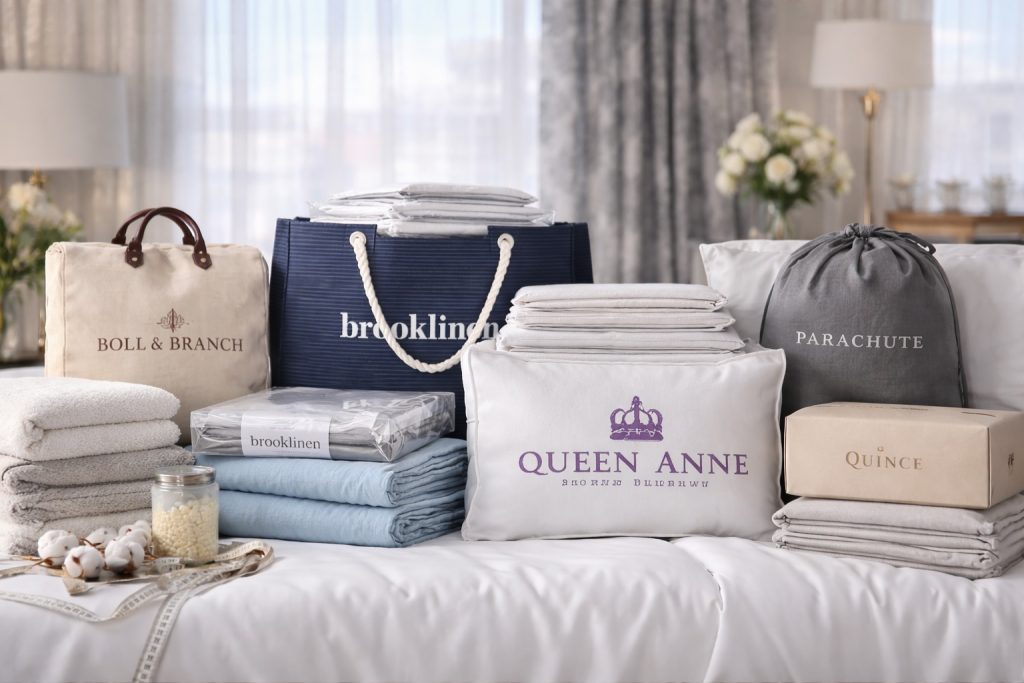

The modern direct-to-consumer bedding industry did not appear overnight. What today feels like a crowded, well-understood category was, just over a decade ago, considered one of the hardest segments of home goods to sell online. Bedding was tactile, personal, and traditionally sold in physical stores where customers could feel fabrics and test pillows in person. The idea that consumers would confidently buy sheets or pillows online was widely viewed as unrealistic.
Yet between 2012 and 2018, a small group of brands fundamentally changed that assumption. Through education, generous return policies, storytelling, and operational experimentation, they reshaped consumer behavior and built what we now recognize as the DTC bedding category.
Queen Anne Pillow (Founded 2012)
Queen Anne Pillow was founded in April 2012, predating the broader wave of DTC bedding brands. At the time, there was no established model for selling pillows online. In fact, many industry voices warned that luxury down pillows would be especially difficult due to high return rates and the deeply personal nature of sleep comfort.
Rather than avoiding these challenges, Queen Anne Pillow addressed them directly. The company emphasized customer education, helping buyers understand how sleep position, fill, and construction affected comfort. More importantly, it implemented a best-in-class return and exchange program that allowed customers to try pillows at home and exchange until they found the right fit.
This approach echoed the logic that made Zappos successful in footwear. Just as Zappos proved that customers would buy shoes online if risk was removed, Queen Anne Pillow demonstrated that consumers would buy pillows online when supported by trust, flexibility, and service. That early experimentation helped normalize online bedding purchases and established patterns that later brands would benefit from.
Source: https://www.queenannepillow.com (brand history and interviews)
Brooklinen (Founded 2014)
Brooklinen launched in 2014 and is widely credited with bringing DTC bedding into the mainstream. The brand focused initially on sheets, emphasizing simplicity, accessible luxury, and strong visual storytelling. By narrowing its product line and communicating clearly, Brooklinen made online bedding feel approachable to a broad audience.
Brooklinen’s success validated the category at scale. It showed that customers were not only willing to buy bedding online, but that they would do so repeatedly when the experience was clear and consistent.
Source: https://en.wikipedia.org/wiki/Brooklinen
Boll & Branch (Founded 2014)
Also founded in 2014, Boll & Branch entered the market with a differentiated focus on ethical sourcing and organic materials. The brand positioned itself around transparency in the supply chain and Fair Trade practices, appealing to consumers who wanted both quality and values alignment.
Boll & Branch expanded the narrative of DTC bedding beyond convenience and price, showing that social responsibility and craftsmanship could be central to an online-first bedding brand.
Source: >https://www.bollandbranch.com/pages/about-us
Parachute (Founded 2014)
Parachute, founded the same year, took a design-forward approach. Starting with premium sheets, the brand emphasized material quality, understated aesthetics, and lifestyle branding. Parachute helped elevate bedding from a utilitarian purchase to a considered design choice, aligning the category with fashion and interior design.
Its growth demonstrated that DTC bedding could command premium pricing when paired with strong brand identity and consistent product quality.
Source:> https://www.parachutehome.com/pages/our-story
Quince (Founded 2018)
Quince launched in 2018 as a broader DTC essentials brand, including bedding as part of its offering. The company emphasized radical price transparency, explaining how traditional retail markups worked and how Quince aimed to remove them. By pairing high-quality materials with lower price points, Quince extended the reach of DTC bedding to more value-conscious consumers.
Quince’s entry marked a later phase of the category’s evolution, one in which consumers were already comfortable purchasing bedding online and increasingly focused on value optimization.
Source: rel=”nofollow”>https://www.quince.com/about
From Experiment to Category
Taken together, these brands illustrate how modern DTC bedding emerged not from a single breakthrough, but from a sequence of experiments. Early innovators like Queen Anne Pillow helped solve the hardest problems first: trust, fit, and returns. Brands that followed refined messaging, expanded aesthetics, emphasized ethics, or optimized pricing.
Today, DTC bedding is a mature category with clear consumer expectations. Free trials, flexible returns, detailed education, and direct brand relationships are no longer novel. They are table stakes. Those norms exist because a small group of companies challenged conventional retail assumptions and proved that bedding could, in fact, be sold online.
Understanding this history matters. It reminds us that what now feels inevitable was once uncertain, and that innovation in consumer goods often comes not from flashy disruption, but from patiently redesigning the experience around the customer.